Saturday, April 19, 2014

When A Scenic Highway Is Really Scenic

We left Yellowstone fairly convinced (though we didn't discuss it) that we'd never see sites as beautiful.  Our next destination? Mount Rushmore. John was particularly excited since he's never seen it.

When we planned our trip we vowed to forego interstates whenever possible and opt for roads less traveled. Whitey at the KOA told John that once we got into South Dakota we should take the Spearfish Canyon National Scenic Byway to  Hill City. Whitey even gave John a book that has a self-guided tour of the byway in it.

Just a note. We've had one of these guides for nearly every leg of our trip and they've been so informative all along the way. Next time you're taking a road trip try to find one.


On the byway we saw steep canyon walls layered with shale, red/pink limestone, and buff-colored limestone. We saw trees that were both deciduous and evergreen. The guidebook said we  saw woodpeckers, blue jays, cliff swallows…we'll just take their word for that. We saw waterfalls and streams. All on a road that wound round and round, up and down for 18 miles. We were wrong about Yellowstone being the last beautiful place we'd see. Spearfish Canyon is one edge of the Black Hills and it's breathtaking.

Wild Bill Hickok was shot here
Kevin Costner's place
We drove through Lead, which is an old west mining town, then onto Deadwood. We were a little afraid Deadwood would be the Silver Dollar City of South Dakota (not that there's anything wrong with SDC), but it was a nice little town with a great history. Wild Bill Hickok, Calamity Jane, Poker Alice, Potato Creek Johnny, Madame Dora DuFran and bunches of other infamous people with great names, all lived and died here.

Deadwood was a rowdy town built on gold and gambling. This is where Wild Bill Hickok was shot in the back holding his "deadman's" poker hand of 2 black eights and 2 black aces. Calamity Jane lived into her fifties and wasn't much of a looker, but she was good at fighting Indians, sharp shooting, and riding horses. She traveled with Buffalo Bill's show for a few years. Even though movies portray C. Jane and W. Bill as romantically involved…they weren't. Still she's buried next to him in the Mt. Moriah Cemetery.

We stopped into the visitors center and the lady gave us a map of a walking tour through town. She talked really fast and circled places of interest, then got a little annoyed with us when we asked a couple of questions. So we set off on our own.

There are lots of casinos in this little town and during the summer there's live music up and down the main street. Kevin Costner owns a restaurant here. We went by it, but didn't see him.
Calamity Jane wasn't cute, but Wild Bill was

People leave things for WBH
Of course we went through the Adams Museum and made the trip up a steep, winding hill on the edge of town to the Mt. Moriah Cemetery. We paid our respects to Wild Bill Hickok and Calamity Jane.

We drove into Hill City and found a campground halfway between the Crazy Horse Museum and Mount Rushmore. It was a KOA and the biggest thing we've ever seen. Fortunately this is the off season. I'm not sure we're up for what this place must look like in the summer and it's jam packed. There's the regular camp sites, plus pools, water slides, wagon rides, a restaurant, a pub, an arcade center, blah, blah, blah. Not our cup for tea, but okay for this time of year. There were maybe 3 other motorhomes there.


scale model of Crazy Horse monument
there's a feather on his head


Crazy Horse monument. No feather. This is a profile--
facing right at the top-most section
After we checked in we headed straight for the Crazy Horse Memorial. Now this is kind of a weird and controversial spot. After Mt. Rushmore was completed, Sitting Bull contacted a sculptor and said, "Hey, we want one of our leaders on a mountain. It should be Crazy Horse." So this sculptor Korczak Ziolkowski, who had worked on Mt. Rushmore until he was fired, said "Sure, I can do that." The first blast was made in 1948. He died before the face was finished so his family has carried on the work. The whole project is a private enterprise and it's apparent that they're very into raising money to fund it. This mountain carving is massive--several times larger than Mt. Rushmore. Work is slow, slow, slow. Hard to know if the Crazy Horse face on the mountain looks like him since there are no photos of Crazy Horse.

It also bothers me that the artist drawings show a big feather sticking up at the back of Crazy Horse's head, but the head that's on the mountain so far has been blasted off smooth on top. Are they going to graft the feather on? Forget the feather? No one had any answers.

Now we were hungry and decided to go into town to get a buffalo burger (low in fat, very tasty). We walked into this little place, and guess what?!?? The first Blues/Blackhawks playoff game was on television. Not only that…EVERY SINGLE booth had its own television. We got to watch the Blues game clear to the overtime. Then we went back to the campground and I became a big hero to Mr. C by finding a live stream of KMOX radio and playing it on my iPhone. They won in a triple overtime! How exciting!!

Kathryn


Thursday, April 17, 2014

Where The Buffalo and Elk and Antelope and Wolves and Bear Roam

Believe it or not, originally we weren't going into Yellowstone National Park.

Then, my soon-to-be-daughter-in-law Kim asked, "So, you're going to Yellowstone, right? It's the most beautiful place I've ever been to."

John talked to one of his customers in Billings, MT and she said, "I hope you're driving through Yellowstone."

So we put Yellowstone--the first national park in the world--on our itinerary.

This time of year only one entrance to the park is open. We entered through Gardiner, Montana and went through the Roosevelt Arch. Teddy placed the cornerstone in 1903 when the main vehicles traveling through were still stagecoaches. We started by seeing the Mammoth Hot Springs area and took an easy, but long and uphill walk around the springs and terraces. The terraces have interesting, but inexplicable names: Minerva, Cleopatra, Aphrodite, Pulpit, Baby, White Elephant Back…

With the snow on the ground there was an interesting mix of hot water from the springs, ice, and steam.  Water flows over the travertine limestone that's formed from the deposits over millions of years.

Because we were limited to just one area of the park we didn't get to see Old Faithful or Mt. Washburn or the canyons, but that's okay because we did see a ton of wildlife that isn't normally as visible. This time of year the buffalo are having their babies, so they're out en masse. We saw hundreds moseying around, grazing, walking down the roads, up hills, through the snow. The babies are red and are called "red dogs." At times we were only 2 or 3 feet away from these massive animals. We saw elk and a wolf, ducks, whooping cranes, and antelope. There was a grizzly hanging out in a tree, but he wouldn't come out. We only know that because there were groups of photographers huddled together on hilltops with their tripods and gigantic lenses trained on that tree. They told us one guy had been there for five days hoping to get a picture of the grizzly, the rest of them had been there two to three days. We don't know who won that waiting game, but bear and photographers were all very patient.

We parked Gypsy right at a camping spot inside the park (just $10) and had a quiet night. We were warned not to wander around after dark because the wildlife roams around and hanging out with them can be dangerous (no kidding).

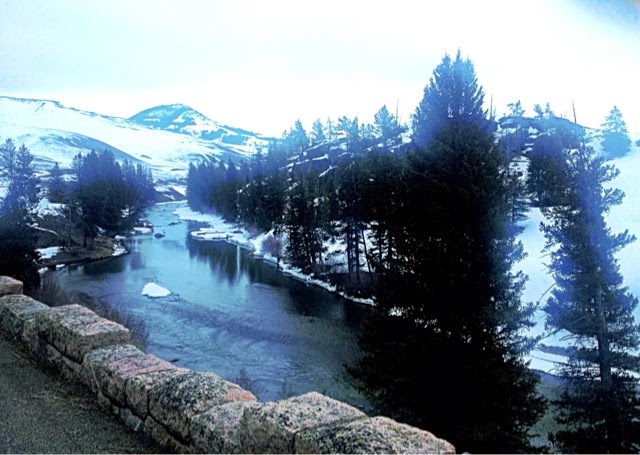
The next day we drove the complete loop of roads that were open. We could have taken a thousand pictures. Every panorama looked like a postcard.

So, thanks Kim and lady who John writes software programs for. Yellowstone was definitely a highlight of our trip.


Roosevelt arch (well, part of it)


Chapel at Yellowstone


Wednesday, April 16, 2014

Quality Time With William F. Cody [AKA Buffalo Bill]

One of our best days was the result of something we couldn't control--the weather.
Our trip so far

We left Douglas in the morning, set off west and north. In Casper we went through another western museum—the National Historic Trails Interpretive Center. This one is very hands-on and interactive. Perfect for kids and people like us who like to push buttons and watch things happen. Its focus (pretty clear from its name) is educating people about the main trails emigrants used to push westward.

I am now 100% convinced that I would never have made it on any of the trails. I'd have frozen to death, died of starvation, drowned, been killed by an Indian, gone crazy, or caught a train back east (if I could find one and had any money left)

I’d never heard of the Bureau of Land Management (BLM) before the standoff in Nevada with ranch owner Cliven Bundy last week. Well, the National Historic Trails Interpretive Center is a cooperative partnership between BLM, the National Historic Trails Center Foundation, and the City of Casper.. Just yesterday Mr. C. purchased a $10 senior (!) lifetime pass that lets him and me into every site administered by a branch of the National Park Service. So! The total cost would have been $12 entry, but we got in free!!! So far we’re $2 ahead on the senior lifetime pass. BTW, senior starts at 62 for the passes.

After the museum we pointed Gypsy to Cody, Wyoming.  That’s about a 4-hour drive from Douglas--totally manageable. Halfway there it started snowing. By the time we made it into Cody the snow was about an inch deep and the lady at the campground told us the weather people were predicting 5-6” of snow. Our plan had been to spend the night in Cody, then drive into Yellowstone.


Well, we were afraid Gypsy might end up in a ditch if we tried to drive her higher into the mountains in a snowstorm so we ditched that plan.

Instead we went out for Mexican food at a local place, then came back, put on our jammies, and fired up the dvd player with movie we'd brought with us “Lost In America.” It’s a classic. We laugh all the way through it. If you haven’t seen it put it on your Netflix list. A couple sells everything, buys an RV, and sets out to find themselves. And it has Albert Brooks in it. 

We also had some Reese's peanut butter cups. Excellent.

So the snow came down in giant flakes. It was beautiful and quiet and peaceful. The next morning we made a quick decision to stay another night in Cody. It was the right decision.

You can get some grub and belly
up to the bar at the Irma Hotel
Cody was founded by Buffalo Bill Cody. Several other places in town were started by him including the hotel, restaurant and bar he started that still operates.


Okay, yes, we went to another museum. Actually it was four museums in one location.  All four museums are located in the Buffalo Bill Center of the West: The Buffalo Bill Museum, The Plains Indian Museum, The Cody Firearms Museum, The Whitney Gallery of Western Art, and The Draper Museum of Natural History. We went through the first four. The Smithsonian is involved in the museums and they have lots of rich east coast donors on a plaque. It’s all first-rate.

Buffalo Bill was really successful in everything he did: Pony Express rider, military scout, international showman, investor, builder….except he did die penniless, three of his four kids died at early ages, his wife divorced him (but later came back to him), and he was on the road all the time.


Me On Buffalo Bill's Saddle


For my brother: Palladin's six shooter
Mr. C and I know nothing about guns. Nothing. But, believe it or not, we both loved The Cody Firearms Museum. There were pistols, rifles, machine guns, cannons….guns used by Matt Dillon, Palladin, Gary Cooper….American, Chinese, German, and Russian arms. It was fascinating.

Oh yeah, when we came in the man at the admission desk asked us for our zip code. Turns out he grew up in St. Louis and went to Chaminade High School right across the street from our house.

Since we left there people ask us, “Did you stop in Cody? Did you go to the museums?”


Loved Cody. It’s very much what I pictured a western town would be like. 

That's a statue of Buffalo Bill in the background


Kathryn


Monday, April 14, 2014

Goodbye Nebraska. Hello Wyoming

The park ranger at Scottsbluff Monument suggested we stop in at Fort Laramie as we drove into Wyoming. Whenever we travel we always find our best places when we take people's recommendations, so we set the GPS for Fort Laramie. Fort Laramie is different than Laramie. Of course, neither one of us has been to Laramie or Fort Laramie so it doesn't make that much difference.

Fort Laramie was an Army post that stood guard over the Oregon, California, and Mormon trails, was a stop on the Pony Express route, and was a staging ground for meetings with Plains Indians. Sometimes those meetings were peaceful and sometimes they went very, very bad. Sitting Bull and Crazy Horse rode into Fort Laramie at various times. This is a National Historic site and most of the buildings at the fort have been restored and you can walk through them. My favorite part was that the single officers' barracks was named "Bedlam".

Mr. C's favorite part was that Fort Laramie was originally called Fort John.


We also stopped at a bridge over the Platte River that was built in 1875 by the army. Since the westward migration began in the 1840s it doesn't take a math major like Mr. C. to figure out that lots of people had to cross that river before the bridge was built. The Platte is a fairly tame river these days, but apparently back then it was far wider, more turbulent, and dangerous. Crossing the Platte River here was one more treacherous area that pioneers heading west had to face. Many animals, children, men, women drowned here. Wagons and supplies had a tendency to sink to the bottom of the river. Not good. Eventually, entrepreneurs came along and set up ferries that were a little safer. But only marginally and they were so expensive that most of the pioneers bet on themselves and would forego the ferry.

These trails were so dangerous--and all were equally dangerous just at different places--that historians estimate there are ten graves to every mile along the emigrant trails. Personally, I hate moving but pioneers moving westward took moving to another dimension that I can't even fathom.

Mr. C. being careful


A little further west is Guernsey, Wyoming where we stopped to see the Oregon Trail Ruts State Historic Site and National Historic Landmark. We hiked up a trail and whoa! There really are still wagon ruts chewed into the rock. Not little grooves either--tracks four to six feet deep in some places. Ironically, along the trail are all kinds of warning signs for us modern-day tenderfoots. "Walk is steep!" "Difficult wheelchair access" "Open--weather permitting" ".9 trail". If their are any pioneer ghosts lingering around Guernsey they're laughing their ghost heads off at us.


Speaking of ghosts…we left Guernsey and headed for Casper, Wyoming.

We're in cattle country
Casper has a great museum, too. The Wyoming Pioneer Memorial Museum. More pioneer exhibits and more on the pony express. I'm so glad we started off the trip with a visit to the pony express museum in St. Joe. Everything makes more sense to us as we follow the trails of those riders and the pioneer emigrants themselves.

We spent the night in Douglas, Wyoming at a campground that had cute shetland ponies. Reminded me of our Smokey….a long, long, time ago.


Kathryn